Binocular Skies: 75 objects, each with its chart and star path
The binocular observer's companion: 75 objects to track down, season by season. For each one, a chart with your binoculars' field, a star path from a bright star, and what you will see.
An ordinary pair of binoculars, a 7×50 or a 10×50, already shows hundreds of objects: the big open clusters, the brightest globulars, a few galaxies and nebulae, double and coloured stars, whole clouds of stars; a 15×70 on a tripod goes further. You still need to know where to look, and what to expect. This guide is the answer: 75 objects chosen because they really show in binoculars, one page each, and a chart that leads to it from a star you can see with the naked eye. It is built from the same data as our sky atlas.
What is inside
- Two hemisphere maps at the front, with the letters of the guide’s regional maps.
- Five chapters: the four seasons, for the evening sky at mid-northern latitudes, then the far south, for a trip to the tropics or beyond.
- Sixteen regional maps, about 45° wide, one group of constellations each, with the chapter’s objects numbered on them.
- One page per object: a 15° chart, the data strip, what you will see, how to find it.
- A legend and the sources.
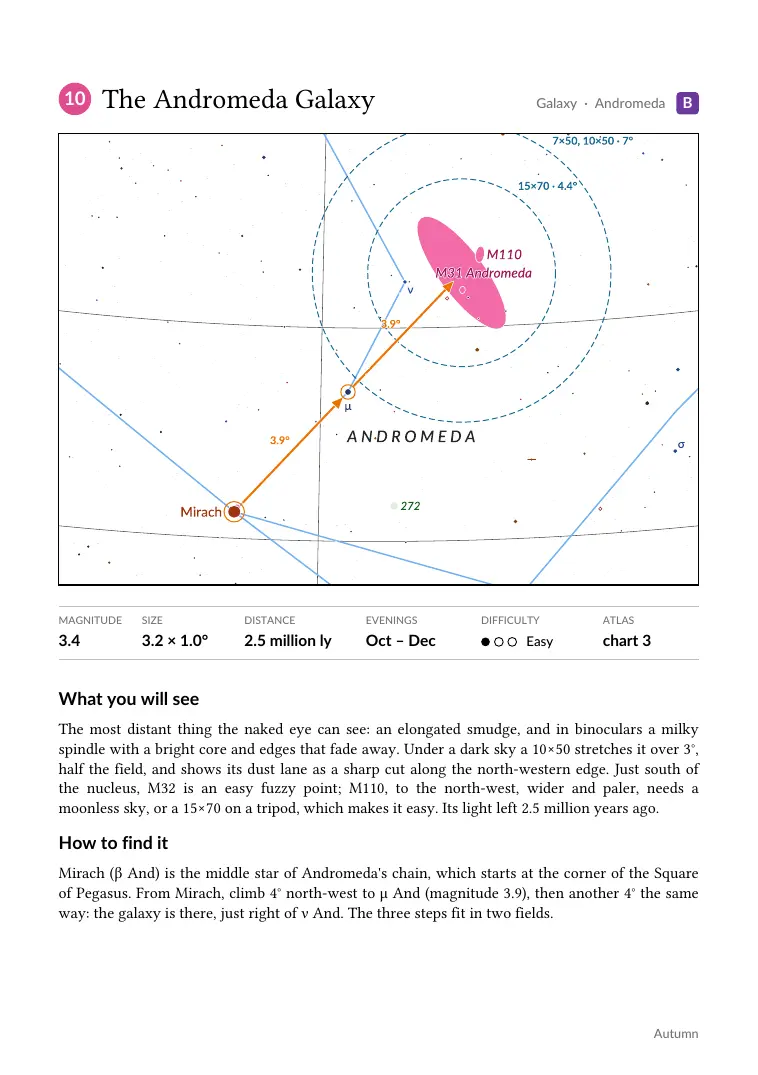
An object’s page
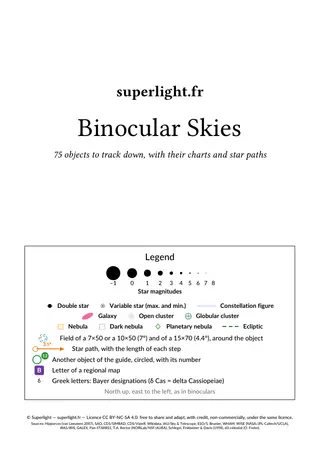
The chart covers 15° of sky, two or three binocular fields, with stars down to magnitude 8.5, the constellation figures and the same symbols as the atlas. North is up and east to the left, exactly as in binoculars, which do not flip the image.
Around the object, two circles give the field of typical binoculars: 7° for a 7×50 or a 10×50, 4.4° for a 15×70. They help judge the size of the object and count fields along the way. The real field depends on the model, from 5° to 7.5° for a 7×50 or a 10×50; the object texts point out, where it matters, what a 15×70 on a tripod adds, and the guide explains how to measure yours.
The star path, in orange, starts from a bright star, visible to the naked eye, and leads to the object in steps, each with its length in degrees. The stars on the path carry their Greek letter: δ Cas reads “delta Cassiopeiae”. Another object of the guide is circled in the colour of its kind, with its number beside it, which links to its page.
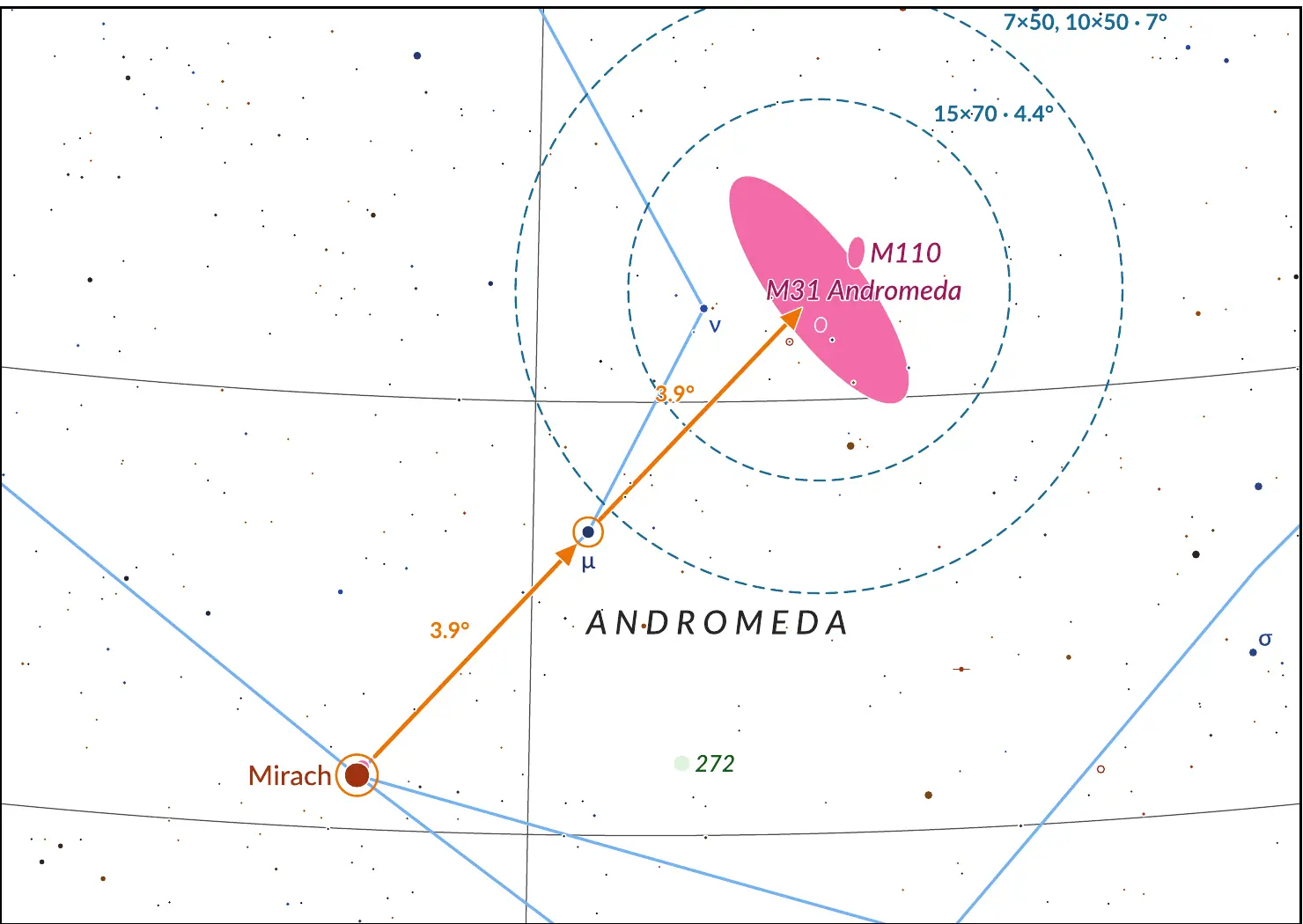
Below the chart, the data strip gives the magnitude (integrated: a cluster of magnitude 6 spread over a degree is far dimmer than a star of magnitude 6), the size, the distance, the three months when the object crosses the meridian around 10 pm, the difficulty on three levels, and the number of the atlas chart where to find it again. Two short texts follow: what a 7×50 and a 10×50 honestly show, and the path, in degrees and in fields.
How the guide is organised
Start from the hemisphere map, where you spot the constellation and the letter of the regional map; the regional map places the object among its neighbours and gives its number; the object’s page does the rest. The objects are numbered 1 to 75 through the book, the regional maps A to P, and everything is linked in the PDF: a click on a number opens the page.
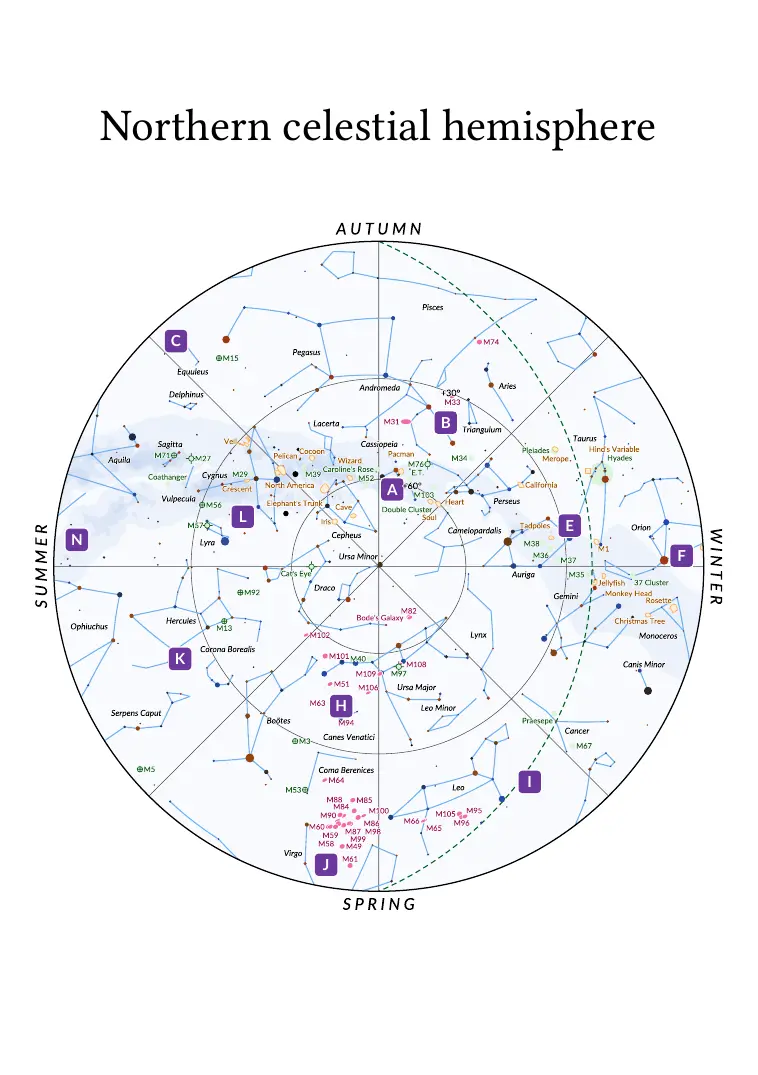
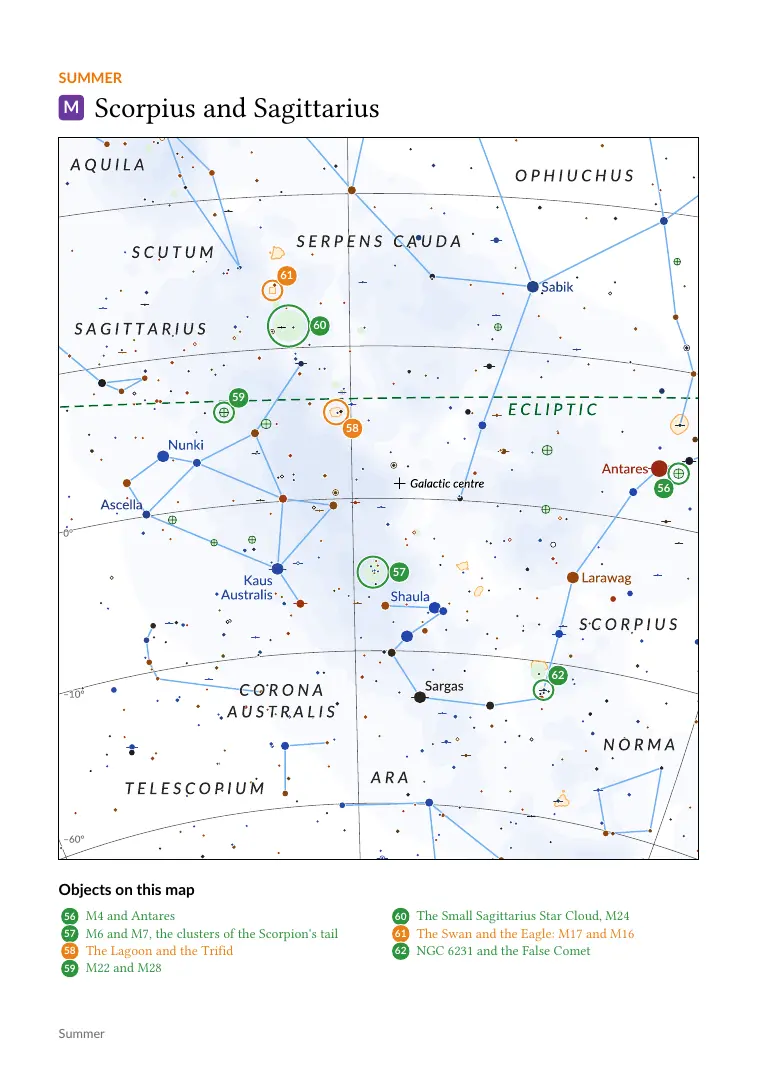
Each chapter opens with a presentation of the season’s sky and the list of its maps and objects. Autumn runs from Cassiopeia to Cetus (the Double Cluster, M31, M33, M15, the Garnet Star, Mira…); winter from Taurus to Puppis (the Pleiades, the Hyades, the three clusters of Auriga, M42, M35, M41, M46 and M47…); spring from Ursa Major to Virgo (Mizar and Alcor, M81 and M82, M3, the Beehive, the Coma star cluster…); summer from Hercules to Sagittarius (M13, ε Lyrae, Albireo, the Coathanger, M27, the Lagoon, M24, M11, Barnard’s E…); the far south from Carina to the Magellanic Clouds (η Carinae, the Jewel Box, ω Centauri, 47 Tucanae…).
The objects
Each object was kept for what 50-mm binoculars show of it under a country sky. A third are easy: seen at first glance, even under an average sky. Others need a dark sky or a little practice. A few challenges are marked as such: the Helix Nebula, M51, the Leo Triplet, the heart of the Virgo Cluster, Barnard’s E. The texts say what you will not see: no colours in the nebulae, no spiral arms, no Horsehead.
Objects that stay low from mid-northern latitudes are flagged; the clusters of the Scorpion’s tail or NGC 6231 need a clear southern horizon.
Printing and using the guide
Print it in A5 or in A4: two pages per landscape A4 sheet at 100% for an A5 booklet, or one page per A4 or Letter sheet, fitted to the page, for larger maps. A 150 g matte coated paper and a spiral binding make a field notebook that lies flat and stands dew better. The file opens in two-page view with the cover alone, like the atlas.
In the field: a dim red light, elbows braced, the guide on the camping table. Start from the starting star, count the fields, compare the eyepiece’s field with the chart. Once an object is found, the atlas takes over to explore around it.
The guide is released under the Creative Commons BY-NC-SA 4.0 licence, like the atlas: print it, share it, adapt it, as long as you credit the source, make no commercial use of it and release your adaptations under the same licence.
Download
Binocular Skies
75 objects to find with binoculars, each with its chart and star path
- 13 MB
- 100 pages
- CC BY-NC-SA 4.0